 Let's Talk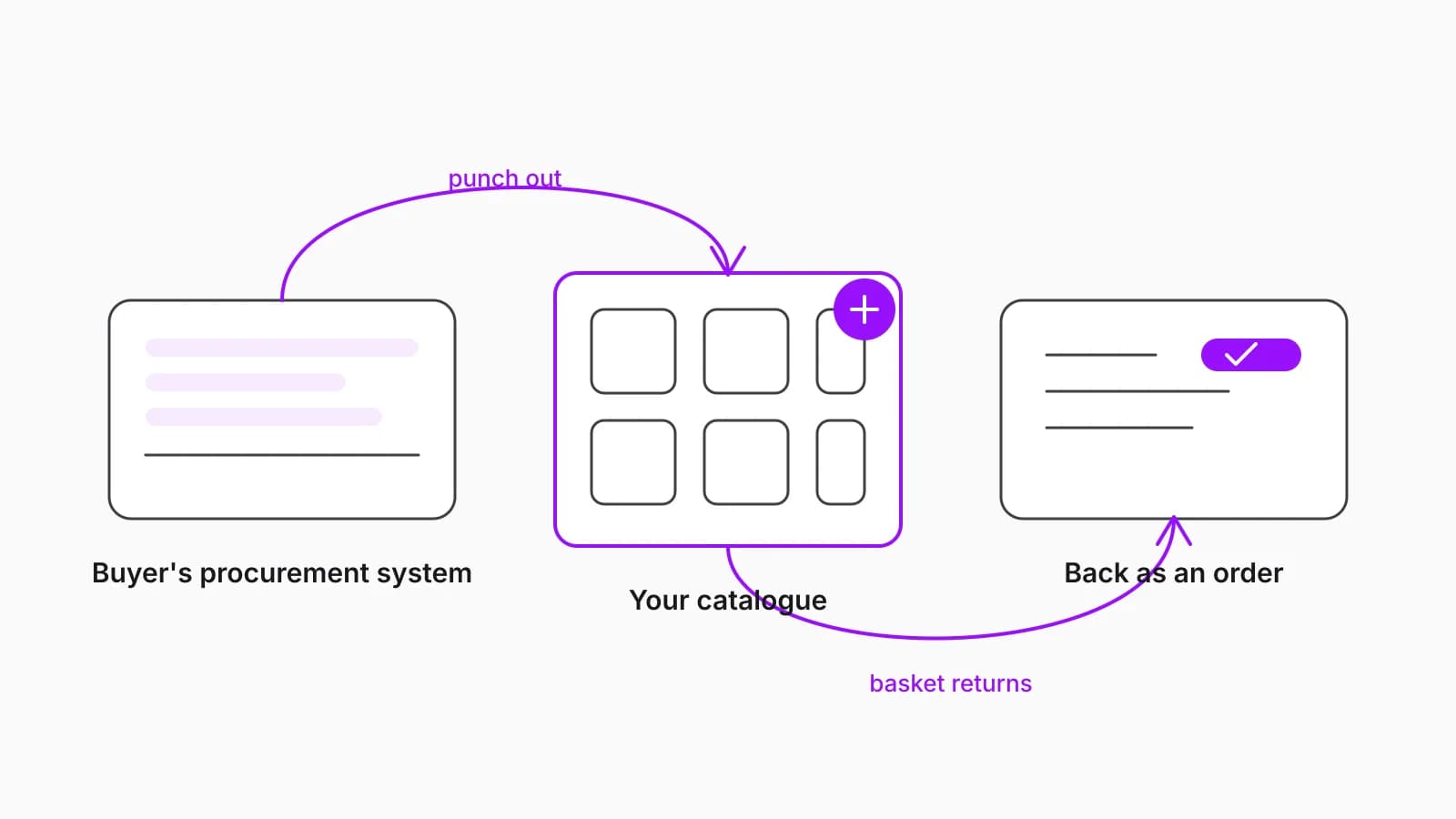
A large customer has just told your sales team they would love to buy from you, but only if you support punchout. Someone has opened a search engine. This is the article they were looking for.
Punchout is a way of connecting your online catalogue to a customer's procurement system, so their staff can shop from you without leaving the tools they already use. That is the whole definition. The rest of this guide covers why large organisations insist on it, what it means for your sales, and what it is not.
The call that starts it
It usually begins well. A buyer at a hospital trust, a university, a national contractor or a facilities management group has found your products, likes your pricing and wants to set you up as a supplier. Then the procurement team gets involved, and a form arrives with a question your sales director has never seen before: "Do you support punchout, and on which platform?"
At that point the conversation moves from "do we want to buy from you" to "can our system buy from you". Those are different questions, and the second one is decided by people who have never visited your website.
Why large organisations do not buy from supplier websites
A small business buys by opening a browser, finding a product and paying by card. A large organisation cannot work that way, because purchasing there is a controlled process rather than an individual decision. Inside a typical enterprise buyer, every purchase has to pass through:
- Approval workflows. A request above a certain value is signed off by a budget holder, sometimes by several, before anything is ordered.
- Budget codes and cost centres. Each line has to be charged to the right department, project or site.
- Purchase orders. Nothing is bought without a PO number, and finance will not pay an invoice that does not match one.
- Audit trails. Who asked, who approved, what was ordered and at what contracted price has to be recorded and kept.
All of that lives inside the organisation's procurement system, whether that is SAP Ariba, Coupa, Oracle, Jaggaer, Proactis or one of the others. So the purchase has to start there. A supplier whose catalogue cannot be reached from inside that system is, for practical purposes, not a supplier at all.
What punchout does, in plain language
Punchout solves this by putting your catalogue inside the buyer's own process. From the buyer's side it looks like this:
- A member of staff opens their procurement system and sees your company listed as an approved supplier.
- They click your name and "punch out" to a version of your online store. It is your site, your products, your images and their contracted prices.
- They fill a basket in the normal way.
- Instead of paying, they return the basket to their procurement system, where it becomes a requisition and goes into the usual approval process.
- Once approved, a purchase order arrives with you, and you fulfil it as you would any other order.
That round trip, out to your site and back with a basket, is the whole idea. The buyer gets the convenience of shopping on a proper storefront. Their organisation keeps every control it needs. You get the order.
There are two main technical standards behind this, cXML and OCI, and we cover the difference in cXML vs OCI: which punchout protocol does your customer use? For a sales conversation, all you need to know is that the customer's platform decides which one applies, not you.
What it means commercially
Being punchout-enabled means being an approved, searchable supplier inside the customer's own tools. Their staff do not need to remember your web address or look for a login. You are simply there, next to the handful of other suppliers the organisation has chosen to work with, and buying from you is the path of least resistance.
Not having it has an equally simple consequence. The buyer either does not purchase, or purchases from the competitor who already has a punchout integration in place. In sectors where procurement is centralised, that decision is often made once, at tender stage, and then stays in place for years.
It also changes the shape of the account. Punchout customers tend to order little and often, across many sites and many users, with the contracted price applied automatically. That is repeat business that arrives without a sales call, which is why suppliers who have done it once usually want it for every large account.
Who typically asks for it
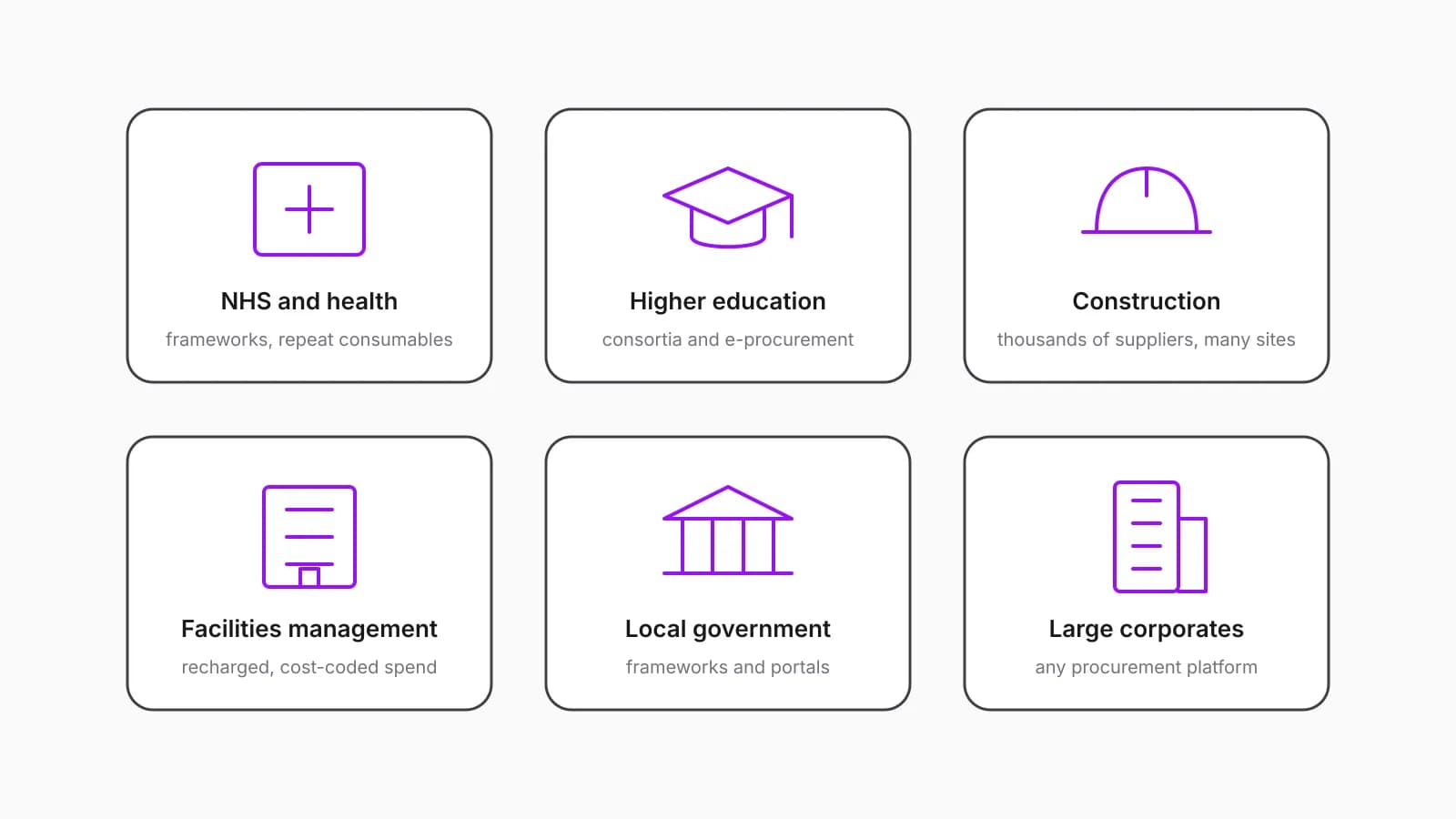
Punchout appears wherever purchasing is centralised and controlled. In the UK that means the NHS and wider health sector, universities and further education, large construction and infrastructure contractors, facilities management providers, local government and any corporate with a procurement function large enough to run its own platform. Each of those sectors tends to favour particular systems, which is why the first thing a supplier hears is often a platform name rather than the word punchout: an Ariba enablement request, a Coupa onboarding email, or an Oracle supplier form.
If your customer list includes organisations like these, or you are bidding for work with them, expect the question. We go through each sector in Who asks for punchout in the UK? It is increasingly a line in the tender rather than an afterthought.
What punchout is not
Because the word is unfamiliar, it gets confused with things that look similar from a distance.
- It is not a marketplace listing. Amazon Business and similar marketplaces put your products on someone else's storefront. Punchout keeps the buyer on yours.
- It is not an EDI feed. EDI exchanges documents such as orders and invoices between systems. Punchout is about the shopping step that happens before the order exists. The two are often used together, but they are not the same thing.
- It is not a discount portal. A password-protected page with special pricing is still your website. Punchout is reached from inside the buyer's system, with their controls wrapped around it.
- It is not a one-off project. Once a customer is connected, they expect it to keep working through catalogue changes, price updates and platform upgrades on both sides.
Where that leaves you
If you sell through Magento or Shopify, your store can be made punchout-ready, and the work sits with whoever does the integration rather than with your sales team. What your sales team does need is the ability to answer the first question confidently: yes, we support punchout, and here is who to talk to about connecting it.
The two things worth finding out on that first call are which procurement platform the customer uses, and who on their side owns supplier enablement. Everything else follows from those two answers. For what the first call with their enablement team will actually cover, see The 10 questions procurement will ask on your first punchout call.
Been asked for punchout?
Takeoff Digital connects Magento and Shopify stores to Ariba, Coupa, Oracle and other procurement platforms, and has done it for suppliers across construction, facilities and the public sector. If a customer has just asked you the question, talk to us and we will tell you what it involves for your business.